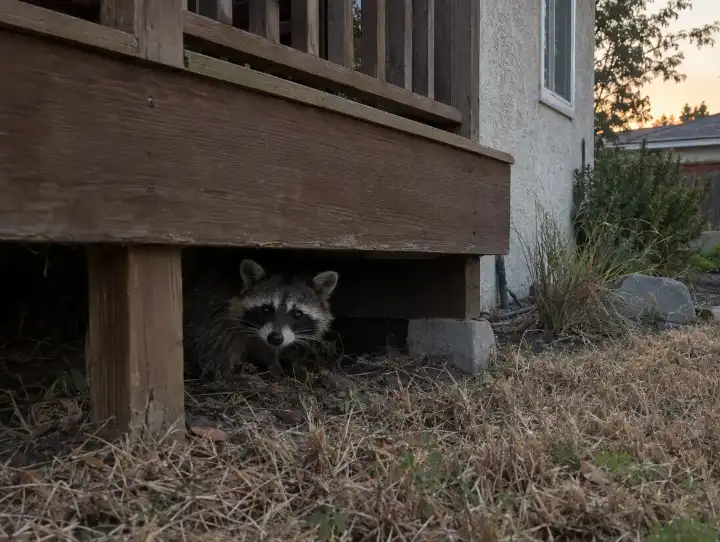
How wildlife exclusion works
- Find the opening and the den. Tracks, smudges, dug soil, torn vents and droppings show where the animal is getting in.
- Check for young. In spring and early summer, babies may be inside. They need to come out with the mother.
- Let it leave. A one-way exclusion door over the opening lets the animal out but not back in.
- Seal and screen. Once it’s gone, the opening is closed. Under decks and sheds, a buried L-shaped wire barrier stops digging.
- Clean up and repair. Damaged insulation, vents or ducting get fixed. See attic cleanup.
Which animal is it?
Raccoons
Raccoons tear into roof vents, soffits and attic gaps and den under decks and sheds. They're strong, so exclusion uses heavy-gauge materials rather than light screening.
Skunks
Skunks den under decks, porches, sheds and slab edges. The usual fix is a one-way door at the den opening and an L-shaped wire barrier buried along the edge so they can't dig back in.
Opossums
Opossums move into crawl spaces, under decks and into garages. They use existing gaps rather than digging, so sealing the openings is usually enough once they're out.
Tree squirrels
Squirrels chew into attics at roof edges and vents, often from overhanging branches. Trimming limbs back from the roof and screening the entry are standard.
Don’t trap it yourself
California regulates how wildlife may be trapped, moved and released, and the rules vary by species. A cornered raccoon or skunk can also be dangerous. Hire a contractor who follows California Department of Fish and Wildlife rules, and ask them to explain their method.
Dead animal smell?
A strong, persistent odor from a wall, crawl space or attic often means an animal has died inside. Contractors can locate and remove it, deodorize the area and seal the entry. Angi lists dead animal removal at about $150 to $250 depending on access.
What it costs
Angi’s 2026 wildlife data: raccoon $300–$450, skunk $300–$600, opossum $150–$350, squirrel $250–$450. Repairs are extra. See the cost guide.
Rodents too?
The same openings that let a squirrel or raccoon in often let rats in. If you hear smaller, faster scratching at night, ask the contractor to check for rodents at the same visit. See rat removal.